Galápagos wildlife calendar: what you see in each month and where
Most Galápagos animals are there all year: sea lions, marine iguanas, blue-footed boobies, giant tortoises. What changes by month is behaviour, such as courtship, nesting and pups, and a few visitors such as the waved albatross and humpback whales. Here is when, and from which town you can see them.
By the Galápagos Boat Tours editorial team · Updated 24 Nov 2026 · Facts checked 24 Nov 2026 · Tour prices and ratings from GetYourGuide, checked 24 Nov 2026
How reliable are wildlife dates?
Less than they look. The calendars on operator websites disagree with each other by weeks, and none we found cites the park’s or the Charles Darwin Foundation’s monitoring data 1. The dates below are approximate, and El Niño years shift them: warm water in 2026–27 means less food for seabirds, penguins and sea lions, and breeding can fail 2,3.
Species by species, and the day trip to see it
| Animal | When (approximate) | Where on a day trip |
|---|---|---|
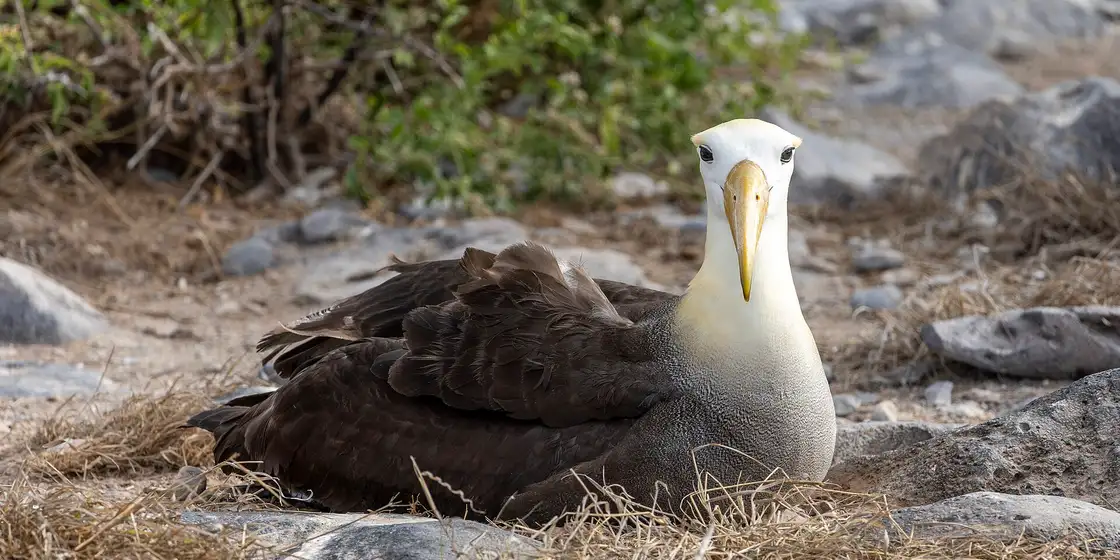
| Waved albatross | On Española about April to December 1 | Española from San Cristóbal |
| Blue-footed booby courtship | Present all year; courtship peak about June to August 7 | North Seymour, Los Túneles, Isla Lobos |
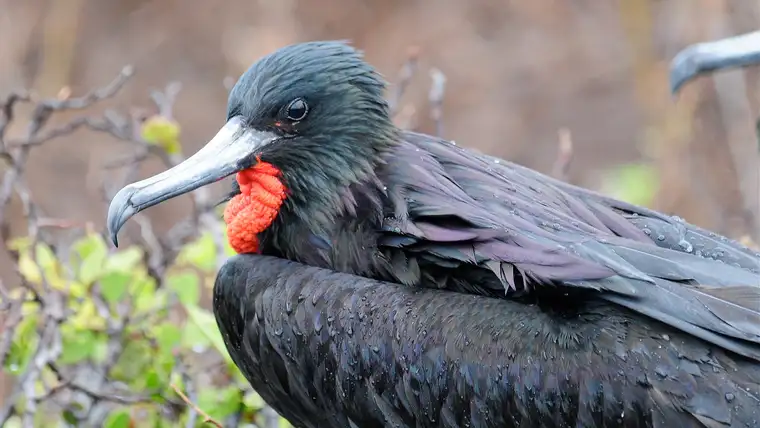
| Magnificent frigatebird | Nesting colonies on North Seymour | North Seymour |
| Humpback whales | Sightings about June to September 8 | Crossings and open-water tours, never guaranteed |
| Green sea turtles | Mating about December–January; hatching from about April 9 | Los Túneles, Santa Fe, Tortuga Bay |
| Sea lions | All year | Santa Fe, San Cristóbal town |
| Galápagos penguins | All year | Isabela (Tintoreras, Los Túneles), sometimes Bartolomé |
| Marine iguanas | All year | Tintoreras, Las Bachas, every rocky shore |
| Giant tortoises | All year | Santa Cruz highlands, breeding centres in all three towns |
| Flamingos | All year | Isabela lagoons, Floreana |
The season behind the calendar
The cool season (roughly June to December) brings cooler water and coincides with the seabird courtship peaks in the operator calendars; the warm season (roughly January to May) brings warmer, calmer water for snorkelling 4,10. Pick your priority, then check the month-by-month verdicts.
We earn a commission if you book through our links to GetYourGuide, Viator or Trip.com, at no extra cost to you. It never changes our ranking. How this works · How we choose
-
North Seymour seabird walk and snorkel
North Seymour with free cancellation · Puerto Ayora, via the Itabaca Channel · 1 day · In the water: snorkel in a calm bay
Snorkel stop after the walk; the listing mentions green turtles.
See prices and dates on GetYourGuide 4.4 (14 reviews on GetYourGuide) from $483 per person checked 24 Nov 2026 See today's price and rating on GetYourGuide -
Española day trip: Punta Suárez and Gardner Islet
Española without a cruise · Puerto Baquerizo Moreno (San Cristóbal) · 9 hours · In the water: calm and open-water snorkels
Snorkel at Gardner Islet.
See prices and dates on GetYourGuide No reviews on GetYourGuide yet from $400 per person checked 24 Nov 2026 See today's price and rating on GetYourGuide -
Los Túneles snorkel at Cabo Rosa
Best snorkel on Isabela · Puerto Villamil (Isabela) · 5 hours · In the water: calm and open-water snorkels
Snorkel in the lava channels of Cabo Rosa: turtles, sharks, seahorses possible.
See prices and dates on GetYourGuide 4.8 (35 reviews on GetYourGuide) from $170 per person checked 24 Nov 2026 See today's price and rating on GetYourGuide
Questions people ask
When can you see albatrosses in the Galápagos?
On Española, roughly April to December according to operator calendars. They are at sea from about January to March.
When do blue-footed boobies dance?
Courtship on North Seymour peaks around June to August in operator calendars, but boobies are present all year and you may see displays at other times.
Where can I see penguins on a day trip?
Around Puerto Villamil and Los Túneles on Isabela, and sometimes near Pinnacle Rock on Bartolomé. The largest colonies are on the western coasts reached by cruise.
Keep planning
-
 Best time to visitWhen to go to the Galápagos for boat trips: monthly sea temperature, rain, wind, crowds and wildlife, plus what the 2026–27 El Niño changes.
-
 North SeymourNorth Seymour day tours from Puerto Ayora: the seabird walk among frigatebirds and blue-footed boobies, best months and the best listings.
-
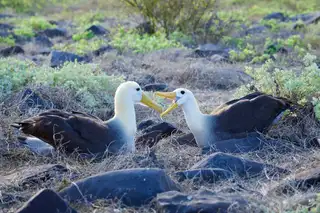 EspañolaEspañola day trips from San Cristóbal: Punta Suárez albatrosses, the Gardner Islet snorkel, the right months and what to ask first.
-
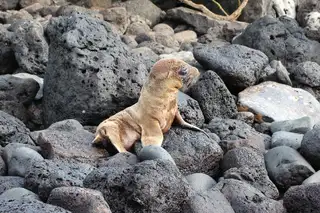 Best day toursThe best Galápagos day tours from Puerto Ayora, San Cristóbal and Isabela, ranked with live ratings and prices, what you do in the water and who should skip each one.
Sources for this page
- Natural Habitat Adventures: Galápagos wildlife seasonality (operator calendar): Waved albatrosses are on Española from about April to December: they arrive in April, lay eggs around May–June and the young fledge by December; the island is reached mainly by cruise.Wildlife dates are approximate and vary from year to year. Undated operator calendar · checked 24 Nov 2026 · secondary source.
- Charles Darwin Foundation: El Niño 2026 in Galápagos (news, 4 September 2026): “El Niño 2026 is already underway ... By July, forecasts indicated a high probability that the event would continue to strengthen toward the end of the year ... During the 1982–1…” Published 4 Sep 2026 · checked 24 Nov 2026.
- NOAA Climate Prediction Center: ENSO diagnostic discussion, 12 November 2026: “El Niño continues to strengthen, with a strong-to-very strong El Niño likely through January-March 2027 (remaining greater than a 79% chance).”The Niño 1+2 region, the part of the eastern Pacific nearest the Galápagos, was about 4.4 °C warmer than normal. Published 12 Nov 2026 · checked 24 Nov 2026.
- Charles Darwin Foundation dataZone: Galápagos climate: The Charles Darwin Foundation describes a hot season in the first half of the year and a cool season in the second half, both varying in length from year to year. Checked 24 Nov 2026.
- Galápagos National Park Directorate: visitor report 2025: “Se identifican dos picos de demanda : marzo – abril (impulsado por visitantes extranjeros) y julio – agosto (mayor dinamismo del mercado nacional) . El valle del año se registra…” Data for 2025 · checked 24 Nov 2026.
- GetYourGuide: Los Túneles tours page: The boat ride to Los Túneles takes about an hour; operators warn that seas can be rough from August to October and that the trip is not advised for people with back or neck problems. 2026 listings · checked 24 Nov 2026 · secondary source.
- Natural Habitat Adventures: Galápagos wildlife seasonality (operator calendar): Blue-footed boobies are present all year; courtship on North Seymour starts around April–May and peaks about June to August, with chicks later in the year.Wildlife dates are approximate and vary from year to year. Undated operator calendar · checked 24 Nov 2026 · secondary source.
- Natural Habitat Adventures: Galápagos wildlife seasonality (operator calendar): Humpback whales are most often seen from about June to September.Wildlife dates are approximate and vary from year to year. Undated operator calendar · checked 24 Nov 2026 · secondary source.
- Natural Habitat Adventures: Galápagos wildlife seasonality (operator calendar): Green sea turtles mate around December–January and the first hatchlings appear around April.Wildlife dates are approximate and vary from year to year. Undated operator calendar · checked 24 Nov 2026 · secondary source.
- NOAA OISST v2.1 via NOAA CoastWatch ERDDAP (dataset ncdcOisst21Agg_LonPM180): Monthly sea-surface temperature for 2016–2025, averaged by us from NOAA OISST data for the open sea 17 km south of Puerto Ayora and off western Isabela.Open-sea values; sheltered bays can be warmer or cooler. Data for 2016–2025 · checked 24 Nov 2026.